How does pharmaceutical 3D printing meet our children's needs?
Administering medicine to a child is not an insignificant act. For some illnesses, children do not always have access to suitable treatments. Pharmaceutical 3D printing is emerging as an effective alternative to meet their growing needs.

Personalized medicine serving our children
Currently, for about 38% of children, the pharmaceutical industry does not offer solutions that meet their needs.
Indeed, children have very varied physiological and anatomical characteristics. The quantity of active ingredient required is therefore highly variable from one child to another. However, for certain pathologies, the pharmaceutical industry does not meet children's needs. This is why pharmacists make up for this shortfall by manually producing medicines as compounded preparations. The manufactured medicines are semi-personalized because compromises have to be made, for example, on dosage adjustment.
The 3D printing technology offered by MB Therapeutics provides a sustainable and tailored response to the specific needs of growing children. Medicines produced by 3D printing are custom-designed, automatically, allowing them to meet the individual needs of each child precisely. Furthermore, the excipients used in these medicines are chosen to be more appropriate for our children compared to traditional liquid suspensions. These liquid suspensions require stabilizing agents that may not fit the profile of the children concerned.
By using pharmaceutical 3D printing technology, it is possible to create safer drug formulations that are better adapted to children's physiology, thereby offering a promising alternative to improve their health and well-being.
MB Therapeutics offers both the ability to produce personalized dosages automatically and with the industrial quality of medicines. This brings new safety and flexibility, which are highly useful in a pediatric context.
Taking treatment: real child's play
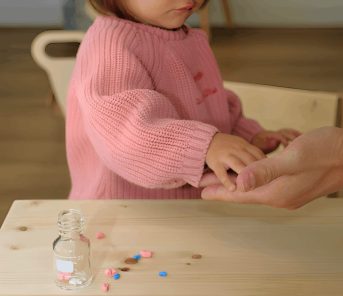
Better acceptability is an asset of 3D printing for young patients. By offering the possibility to create shapes and colors according to our children's tastes and preferences, they have the choice of orange, blue, a sun, or a star. Taking medication, which is often difficult, will no longer be constrained by size and shape. This adaptability enabled by custom medicine printing ensures our children's comfort and revolutionizes the medical experience.
« We know that children have unique medicine needs, and we are determined to improve their experience by offering oral forms adapted to their needs« , Stéphane Roulon
For certain age groups, the risks of choking and ingestion are also a concern. As for liquid suspensions, they can contain excipients (inert pharmaceutical ingredients) with known effects or contraindications for certain age groups. This is compounded by the risk of administration errors with dosing pipettes. 40% of parents make errors in administering treatment to their children , which can cause adverse effects for the child.
This personalization therefore goes beyond aesthetics to touch on the practical aspects of treatment. Dosages precisely adapted to each case prevent issues related to under-dosing or over-dosing.
Conclusion
The 3D printing of personalized pediatric medicines offered by MB is a promising advancement in the pharmaceutical field. By offering custom solutions tailored to our children, taking medicine becomes a simpler and more inclusive step.
©️2026 MB Therapeutics