Comparison of Gel Extrusion Technologies: Piston, Air, and Screw, for the Manufacture of Pharmaceutical Medicines
In a constantly evolving pharmaceutical sector, pharmaceutical 3D printing makes it possible to visualize a new way of producing personalized medicines on demand. Several 3D printing technologies exist on the market. Among these techniques, 3D printing from pharmaceutical gels is particularly promising in the new era of individualized medicine. The 3D printing process based on the extrusion of gels relies on an uninterrupted flow of material delivered from a cartridge. This method offers various advantages, notably the ability to print a wide range of viscosities by adjusting pressure. It also allows the co-extrusion of two distinct gels. Furthermore, 3D printing of pharmaceutical gels operates at moderate temperatures. This technology is therefore ideal for thermosensitive components.
Several gel 3D printing technologies exist on the market. Each with their advantages and disadvantages, which is why we invite you to discover the three main ways to extrude pharmaceutical gels by 3D printing.
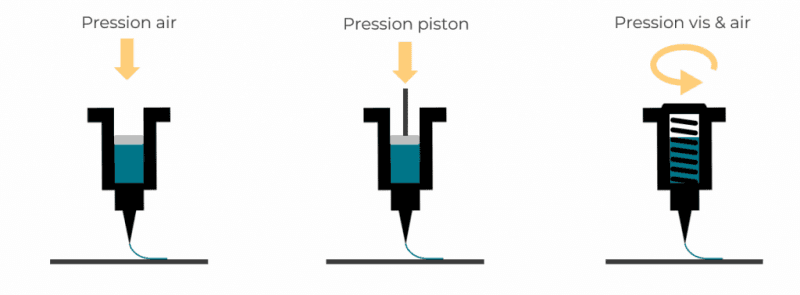
3D printing of gels by air pressure
Pharmaceutical 3D printing using air pressure is a widely adopted technique due to its simplicity of execution. The application of air pressure pushes a piston in contact with the material in the syringe, facilitating its extrusion through a nozzle. This process allows the material to be deposited on a plate, thus promoting the manufacture of personalized and specific medicines.
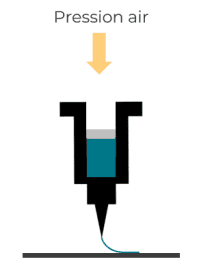
Diagram of gel extrusion by air pressure
This method may experience delays in deposition due to the compression of the gas contained in the cartridge. This will result in decreased printing accuracy. In systems utilizing air pressure, the flow rate cannot be directly controlled. The flow rate is dependent on the applied pressure, the nozzle size, and the environment.
This characteristic can lead to variations in flow rate. It is also important to note that environmental conditions can influence flow rate and induce deposition inaccuracies. For example, temperature, humidity, as well as parameters related to cartridge filling and material properties, such as inhomogeneities or batch-to-batch variations, can impact the quality of printed medicines. Careful consideration of parameters is essential to ensure the success of 3D printing of pharmaceutical gels and personalized medicines.
3D printing of gels by mechanical pressure
Pharmaceutical 3D printing of gels, using the mechanical pressure technique, allows the precise extrusion of pharmaceutical gels. This technology extrudes the gel thanks to the force exerted on a piston in contact with the material contained in the dedicated syringe.
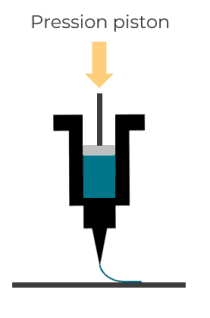
Diagram of gel extrusion by mechanical system
Mechanical pressure systems offer theoretically more precise control of extruded volume than air-pressure 3D printing technologies. Indeed, through the movement of the piston in the pharmaceutical cartridge, it is possible to control the flow rate. Although the flow rate can be independently regulated by adjusting the piston speed, there may be delays due to the elasticity of the gels and variations due to the friction of the piston on the syringe. Integrating a peristaltic pump onto the extruder helps overcome these issues, but brings increased complexity, additional costs, and extra challenges in terms of maintenance and cleaning of the 3D print head. This 3D printing technique generally does not allow printing of very viscous materials. In fact, there is a risk of material leakage past the piston when high mechanical pressure is applied. Nonetheless, this technology still opens the door to creating personalized medicines through 3D printing.
3D printing of gels by volumetric dosing
3D printing of medicines by volumetric dosing operates using an Archimedes' screw. The latter will convey the material to the outlet of the 3D print head.
The 3D printing of pharmaceutical gels by volumetric dosing represents a significant advance in the manufacture of personalized medicines. This method involves meticulous control of the volume of gel-like material extruded with each layer. This ensures high precision in creating complex structures.
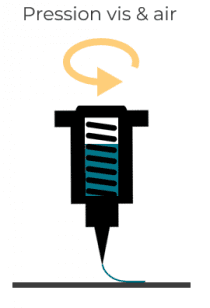
Diagram of gel extrusion by volumetric dosing
Unlike pharmaceutical 3D printing methods by mechanical and air pressure, where mechanical or pneumatic forces are used for extrusion, volumetric dosing eliminates flow delays and variations due to friction. Volumetric dosing systems allow a precise and independent adjustment of the flow rate according to the material. These systems guarantee better reproducibility and consistent quality of the printed pharmaceutical products. Very viscous materials can be printed using this technology. Furthermore, this approach reduces the complexity and costs associated with integrating additional mechanical or pneumatic components. However, the dead volume in the conduit can generate a minor loss of material.
3D printing of pharmaceutical gels by volumetric dosing paves the way for a more reliable, efficient, and personalized production of medicines, while minimizing the technical challenges encountered with other extrusion methods. This is why the team MB Therapeutics has chosen to integrate a volumetric dosing pharmaceutical 3D printing technology that requires no cleaning for rapid formulation development. This allows users to benefit from the advantages of volumetric dosing 3D printing technology without the drawbacks.
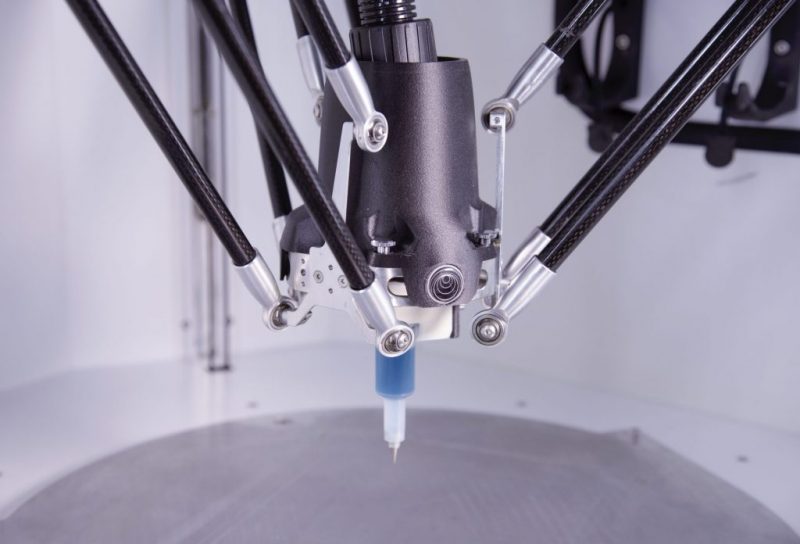
GEL technology integrated into the pharmaceutical 3D printer: MED-U Modular
Conclusion
In conclusion, the evolution of pharmaceutical 3D printing technology offers exciting prospects for the future of personalized medicine, especially for improving care provided to children. Among the various extraction methods of pharmaceutical gels, volumetric dosing stands out for its precision and potential to eliminate the challenges associated with flow delays and variations. This promising approach offers a reliable solution for the production of custom-made medicines, while reducing technical complexity and costs. It is clear that 3D printing of pharmaceutical gels is a key option for delivering quality care to children and patients of all ages, thus paving the way for personalized medicine adapted to each individual's unique needs.
Previous article
Next article
©️2026 MB Therapeutics